


DERIVATIVES#
What is a derivative? A derivative is a contract whose value depends on the price of another asset. That asset, called the underlying, can be a stock, a currency, a commodity, an interest rate or an index. Here I deal with derivatives on the S&P 500 index, which are by far the most liquid and heavily traded in the world and have desirable characteristics. A derivative has no intrinsic value of its own: it derives it, literally, from the underlying. If the index goes up or down, a derivative written on the index moves accordingly.
A derivative is a redundant security, meaning a financial instrument whose payoff profile can be replicated exactly by combining other securities already available in the market. In theory, its return in every possible state of the world over time can be obtained as a combination (a portfolio) of other assets. For this reason it adds no new investment opportunities: it does not expand the “space” of attainable payoffs. In practice, however, replicating a derivative with a dynamic portfolio of the underlying and the risk-free asset is anything but simple, and this is the main reason derivatives are used in place of the underlying. There are two concrete advantages.
The first is cost. To obtain a given financial exposure, using a derivative is often cheaper than trading the underlying. The difference is not marginal: it can be as much as an order of magnitude once you account for the transaction costs of a strategy that requires continuous rebalancing.
The second is accessibility. In many cases the underlying cannot be traded directly, or only under severe constraints. A farmer cannot sell a crop that has not yet grown; some markets restrict short selling; certain investors cannot physically hold particular assets. Derivatives get around these obstacles.
Derivatives were not born for gambling. They were born to manage risk efficiently and to overcome operational barriers. That they have also been used for gambling, sometimes disastrously, is a matter of who wields the instrument, not of the instrument itself.
Behind a universe of derivative products with ever more baroque names (swaps, exotic options, structured products with three- or four-letter acronyms) hide only two fundamental architectures: the mutual commitment (the forward contract — called a futures contract when exchange-traded, a forward when over-the-counter) and the right to choose (options). Every other product is an assembly of these two. The next two pages (Futures and Options) cover them one at a time; here I want to pin down three ideas that apply to both and that you will find throughout the site.
Linear and nonlinear payoffs#
The first idea is the distinction between linear and nonlinear payoffs. The future has a linear payoff: if the index moves by one point, the contract moves by one point (times the multiplier), always, in both directions. It is pure exposure, with no opinions attached: a photocopy of the underlying with leverage built in. The option, by contrast, has a nonlinear payoff: below the strike the put is worth the difference, above the strike it is worth zero. This curvature — in the jargon, convexity — is what makes options instruments of insurance rather than mere exposure, and it is also why they carry a price (the premium) that the future does not. Convexity is valuable to whoever buys it, because it caps losses and leaves gains open; and by symmetry it is costly to whoever sells it, who collects the premium in exchange for an asymmetric loss profile. This entire site revolves around one question: what is selling that convexity worth, on average? The answer is the volatility risk premium of the Volatility risk premium page.
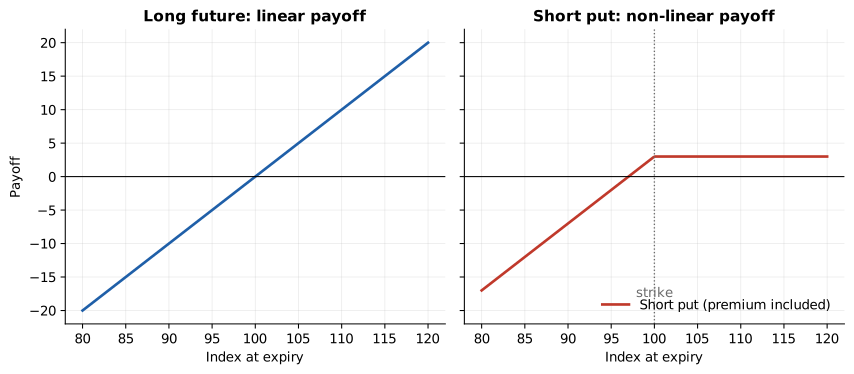
The two architectures side by side: the future replicates the index point for point; the short put collects a fixed premium in exchange for an open-ended loss below the strike. The curvature is the merchandise.
Zero sum, but only in payoffs#
The second idea concerns the famous argument that “derivatives are a zero-sum game”. It is true in an accounting sense: for every dollar gained by whoever is long there is a dollar lost by whoever is short, because the contract is bilateral and produces nothing. But from this accounting truth it does not follow that nobody can profit systematically, for two reasons.
The first is that the zero sum holds for payoffs, not for utility. When the farmer sells wheat forward to the miller, both are better off even though one of them, after the fact, will have “lost” relative to the final spot price: each has eliminated a risk they did not want. The derivatives market is a market for risk transfer, and in risk-transfer markets whoever agrees to carry the unwanted risk gets paid to do so. The insurer earns systematically from premiums while operating in a “game” that, policy by policy, is zero-sum with the insured. The insurance provider is not beating the insured: it is selling a service.
The second reason is that the counterparties are not symmetric in their constraints. As you will see when we talk about edge (the Edge page), most of the demand for index put options comes from institutional investors obliged or strongly incentivized to hedge, while supply is limited by the capital and risk aversion of intermediaries. When demand and supply are structurally imbalanced, the equilibrium price embeds a premium for whoever stands on the scarce side. Zero sum in payoffs, but not in risk premia.
How they are priced: the Q world and the P world#
The third idea is the most important of the entire section, because without it the VRP is incomprehensible. Derivatives are priced by absence of arbitrage: since the payoff is replicable (at least in theory) with a portfolio of the underlying and the risk-free asset, the price of the derivative must equal the cost of the replication, otherwise someone would buy one and sell the other and pocket a riskless profit. From this principle follows a surprising result: the price of a derivative does not depend on the expected return of the underlying, but only on its volatility (plus the interest rate, dividends and time).
The technical way to say it is that derivatives are priced under the risk-neutral measure, known in the literature as the Q measure, distinct from the “physical” measure P that describes real-world probabilities. Under Q, all assets earn the risk-free rate: it is a fictitious world, a computational convention that already embeds market participants’ risk aversion in prices. The crucial point is this: option prices reflect Q probabilities, but your profits and losses are realized in the P world. Every risk premium in finance is exactly the difference between the Q world and the P world. The equity risk premium exists because stock prices discount future cash flows at a rate higher than their physical expected return. The volatility risk premium exists because options price a volatility (and above all tail probabilities) systematically higher than what subsequently materializes. You will see on the Volatility risk premium page that, at one-day maturities, the crash probabilities implied by prices can exceed the physical ones by an enormous factor: whoever sells options is, in essence, selling Q probabilities and pocketing the difference when the P history plays out. When things go well.
Why the S&P 500 in particular#
I close with a practical choice that shapes everything else on the site: I work almost exclusively with derivatives on the S&P 500 index, and specifically with SPX options listed on the CBOE and ES/MES futures listed on the CME. There are four reasons.
Liquidity. They are the most heavily traded derivatives on the planet: minimal bid-ask spreads, book depth even at distant strikes, the ability to get in and out in any market condition (almost: see the Tail risk page on flash crashes). For a strategy that lives on premiums worth a few cents, the spread is a first-order cost.
Cash settlement. SPX options are cash-settled: at expiry you neither receive nor deliver shares, only the difference in cash. No early-assignment risk, no unwanted stock positions to manage.
European style. SPX options can only be exercised at expiry. This eliminates the early-exercise risk that plagues American options on single stocks and ETFs, and makes put-call parity — which I will use as a conceptual tool (Options page) — hold at every instant.
Built-in diversification. Selling options on an index of 500 stocks exposes you to systematic risk but not to idiosyncratic risk: no earnings miss, no accounting fraud, no takeover can blow through the strike on its own. The flip side is that the risk left over is precisely the one that cannot be diversified away: the market crash. And that is exactly why it gets paid.
A note on nomenclature, because the alphabet soup on the option chains is confusing: SPX are the index options with the classic monthly expiry (third Friday, morning settlement), SPXW the weeklies expiring every day of the week and settling at the close — these are the ones I use for one-day maturities. XSP are the mini version (one tenth of the notional), useful for small accounts but with proportionally worse spreads. Options on SPY (the ETF) are American-style and physically settled, so I do not consider them.
The “almost” in that almost exclusively deserves to be declared right away, because it is a system-level exception, not an oversight: the site’s third strategy, the CTA trend following, operates by construction on diversified futures — indices, Treasuries, currencies, metals, energy, agriculturals — because its engine is diversification across sectors, not the depth of a single market. The four reasons above hold for the options book, which stays entirely on the S&P 500; the futures of the other sectors arrive halfway through the site, with a page of their own.
The next page (Futures) covers the future, the linear instrument — first the options book’s hedging tool, later in the site the engine of a strategy in its own right; the one after (Options) the option, the convex instrument. Then you get to the reason you are here: the premium (Volatility risk premium) and how to harvest it efficiently (Capital efficiency). The section closes with a case study of who buys that premium wholesale, and of how they tell the story: The curious case of Universa Investments.