


Capital efficiency#
We have established that the VRP exists (Volatility risk premium page). The next question is how much it pays, and here comes the first cold shower: in absolute terms, little. A deep OTM 1DTE put sells for about 15 cents, that is, $15 per contract. Repeated 252 times a year on a notional of roughly $730,000 (one SPX contract with the index at 7,300), that makes 15 × 252 / 730,000 ≈ 0.5% per year on notional. Half a percentage point. If collecting it required parking the entire notional in cash, the game would not be worth the candle: a T-bill pays more with no tail risk. The entire viability of volatility selling therefore hinges on a seemingly bookkeeping question: how much capital is actually needed to support the position. This is the subject of capital efficiency, and it is the point where many forum discussions go off the rails.
Cash secured put: the inefficient version#
The “prudent” way to sell a put is the cash secured put (CSP): you sell the put and park in cash the full value of the strike, ready for possible assignment. It is the version brokers grant to everyone, and it is also a demonstration of how a good idea can be made inefficient. With the CSP the strategy’s return is the premium divided by the notional — the measly 0.5% from before — plus the return on the collateral. The capital works only once. Worse: to build the CSP you must not have that capital invested in stocks and bonds, so you harvest the VRP by giving up ERP and TRP. You are buying one risk premium by selling two others. On these terms, the forum critiques (“a money market fund pays the same”) would even be right. This is also why you do not see many short vol ETFs selling CSPs around.
Naked puts on margin: the capital works twice#
The solution is to change the architecture. I keep my long-term portfolio — stocks, bonds, ETFs, whatever I already own — and use that portfolio as collateral to sell naked puts (not backed by dedicated cash) on margin. The broker does not ask for cash equal to the strike: it asks for margin, that is, a fraction of the notional computed on the position’s risk. The result is that the same capital harvests ERP and TRP (through the portfolio) and VRP (through the options overlay) at the same time. It is what the recent literature calls return stacking: stacking different risk premia on the same dollar.
Option income thus becomes additive: it does not replace the portfolio’s return, it adds to it. The recurring objection in the community goes “a money market fund makes 2% too”, failing to grasp that the 2% from options arrives on top of the account’s dividends, coupons and capital gains — it is alpha on margin, not return on capital. When you see the reference track record’s numbers on the TRPS page, always keep this architecture in mind: the correct comparison is not “options versus T-bills”, but “portfolio with overlay versus portfolio without”.
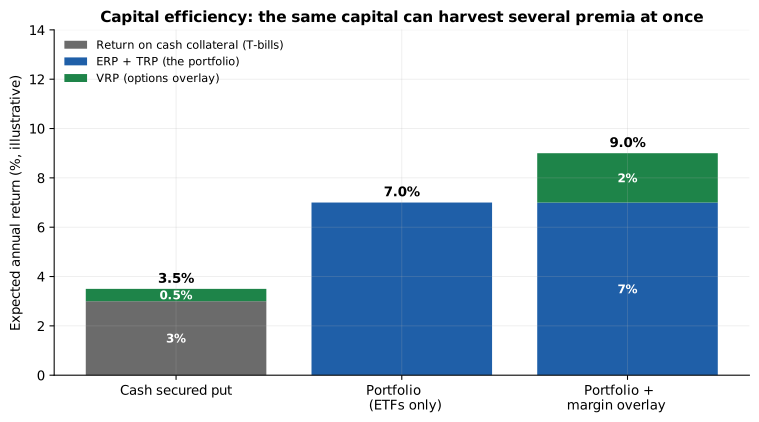
The correct comparison: the CSP harvests VRP by giving up ERP and TRP; the margin overlay stacks them all on the same dollar. Illustrative numbers.
The noble analogy is Berkshire Hathaway’s insurance float. Buffett collects insurance premiums today and pays claims tomorrow: in the meantime that money — the float — is invested in his businesses. If underwriting is disciplined (premiums exceeding claims), the float is leverage at negative cost: you get paid to use it. The put seller on margin does the same thing in miniature: the portfolio guarantees the capacity to pay the “claims” (the puts that go ITM), and as long as underwriting is in the black, the leverage is remunerated rather than costly. With one difference never to forget: Buffett has vast reserves and claims uncorrelated with his investments; I have a margin account and claims that arrive exactly when the collateral loses value. The correlation between the claim and the collateral is the original sin of volatility selling, and the entire Risk management section exists to manage it.
Reg-T, portfolio margin and SPAN: how much margin is really needed#
The numbers depend on the margin regime. For example, with Interactive Brokers — the reference broker for these strategies — under the base regime (Reg-T) naked index options are prohibitive: margin is computed per position, with punitive formulas. The turning point is portfolio margin (PM), available on accounts above a threshold ($110,000): margin is computed by simulating shock scenarios on the entire portfolio (for index options, typically moves of the underlying up to ±8-12% plus volatility shocks) and requiring capital equal to the worst simulated loss. A 7% OTM put one day from expiration produces, in these scenarios, modest simulated losses: the required margin is a small fraction of the notional. On futures the principle is analogous (the CME’s SPAN system): a few percentage points of notional per contract, and it is the regime that also makes the site’s third strategy possible — a leg of diversified futures held entirely on margin, without a dollar of dedicated capital (CTA trend following page). Practical consequence: with a PM account, the same million-dollar portfolio can support put selling for 3-4 million of notional without getting near the limits — the 3-4x leverage we will meet again in the TRPS.
Three warnings, because margin is a dog that bites.
Before the warnings, a numerical example to give the abstraction some flesh. A $1,000,000 PM account, invested in a 60/40 portfolio of ETFs and preferreds: the margin absorbed by the portfolio itself typically leaves several hundred thousand dollars of excess liquidity. A 1-day SPX put 7% OTM requires under PM, in a calm regime, on the order of $20-40,000 of margin per contract (the exact number comes from the broker’s what-if tool, which is worth querying before every order, not after). Four to five contracts — that is, 3-3.5 million of notional, the trade’s 3-4x leverage — therefore tie up $100-200,000: a minority fraction of the available liquidity on the good days, which however can double or triple on the bad days, when the PM scenarios widen and the collateral is worth less. That is why sizing is done on stressed margin, not on any given Tuesday’s margin.
Margin is procyclical. On stormy days brokers raise requirements and the PM scenarios widen, precisely while your positions are losing value mark-to-market. Required capital grows as available capital shrinks. The operating rule is to never use more than a fraction of the available margin on quiet days, because on bad days that fraction doubles on its own.
Maximum margin is not maximum leverage. That the broker allows you 6x does not mean 6x is sensible. Correct sizing follows not from margin but from ruin risk: I anticipate the conclusion of the Ergodicity page — leverage should be chosen so that the plausible worst-case scenario (including the overnight gap that jumps the stops) leaves the account alive and operational, not so that the normal scenario maximizes return. IB also applies an exposure fee to accounts with elevated tail risk: when the broker starts charging you insurance on yourself, that is a price signal worth listening to.
The collateral must be productive but stable. A collateral portfolio of cryptocurrencies and beta-1.5 growth stocks amplifies the cursed correlation above. The reference track record’s choice — a mix of stocks, preferred shares and bond funds — is not accidental: decent current yield, contained volatility, reasonable margin haircuts. Personally, I use a 70/30 portfolio where the bond side is a mix of nominal bond, linker and money market ETFs serving as a margin cushion. Margin is not an opportunity cost but another line of return: the household version of an insurer’s technical reserves, invested but ready for the claims.
The big picture#
Let me recap the complete architecture, because it is the frame on which I will mount everything: (1) a long-term portfolio that harvests ERP and TRP and serves as collateral; (2) an overlay of options sold on margin that harvests VRP, sized with moderate leverage on notional (3-4x as an order of magnitude, but the right number comes out of the risk analysis, not this page); (3) an unused margin cushion as a reserve for the bad days; and (4) — the same principle extended to a different premium — a leg of diversified futures on margin that stacks the trend premium onto the same collateral as well (CTA trend following and The third leg pages). The unlevered 0.5% becomes 1.5-2% per year on the account from the 1DTE leg — an additional return that adds to the collateral’s, with which a portfolio at 70-75% equities can keep pace with one at 100% with lower volatility.
Sounds good. Too good, and this is exactly the point where this site changes tone: the leverage that multiplies the premium multiplies the tail identically, and capital efficiency without risk management is just a faster way to go to zero. Before the tone changes, though, I close the section with an instructive story about the power of denominators, told from the opposite side of the table: The curious case of Universa Investments.