


Futures#
The future is the simplest derivative there is: a mutual commitment to exchange the underlying (or its cash value) at a future date, at a price fixed today. No premium to pay, no choice to exercise: just a symmetric obligation. Whoever is long gains if the price rises and loses if it falls; whoever is short, the exact opposite, dollar for dollar. It is the linear instrument of this site’s strategies, and it plays three roles: in the DHCS strategy (DHCS page) it is the delta-hedging instrument; in the TRPS (TRPS page) it is the night sentinel — the hook on which the bot’s overnight watch is armed and, in the last resort, plan B for emergencies — being the only index derivative that trades almost 24 hours a day; and in the site’s third strategy, the CTA trend following, it stops being the tool and becomes the merchandise: the directional position, long or short, with which the trend is chased across six sectors.
The mechanics: marking-to-market and margins#
Unlike an OTC forward, the exchange-traded future does not let credits and debits accumulate until expiry: it settles them every day. This is marking-to-market: at the close of each session, the clearing house calculates the price change and moves the corresponding cash from the loser’s account to the winner’s. The contract restarts every morning “reset” at the previous day’s settlement price. This mechanism, together with the clearing house interposing itself as everyone’s counterparty, all but eliminates credit risk: nobody can build up a loss against you larger than one day’s move, because the loss is settled every evening.
To guarantee that daily settlement, the broker requires an initial margin when the position is opened and a maintenance margin below which a top-up request (margin call) is triggered. Beware of a common misunderstanding: the margin is not the price of the future, nor a down payment. It is a security deposit, typically between 5% and 15% of the notional value for index futures, which remains yours and earns interest (or can be invested in T-bills). Hence the built-in leverage: with the E-mini’s initial margin you control a notional roughly 10-15 times larger. Leverage is not an optional feature of the future: it is its nature. It is up to you to decide how much of it to use, keeping plenty of cash on hand beyond the required minimum. Whoever keeps the bare minimum on margin has already decided, without knowing it, that the first bad week will liquidate the position.
A numerical example to nail down the mechanics. On Monday you sell an E-mini at 6,800; on Tuesday the future closes at 6,830. Marking-to-market debits your account 30 points × $50 = $1,500, credited to the long counterparty; on Wednesday the contract “restarts” from 6,830. If in the meantime your balance has fallen below the maintenance margin (say $16,000), the broker demands a top-up to the initial margin within the day — and if it does not arrive, the broker liquidates for you, at whatever price there is. Note the difference from a stock bought and forgotten in a drawer: the future settles losses in cash every evening, and therefore demands active liquidity management. It is a constraint, but also a hygienic virtue: it makes risk visible day by day, without the merciful accounting illusion of “I’m not selling anyway”.
The index contracts you will meet most often in these pages are two. The E-mini S&P 500 (ES) has a multiplier of $50 per index point: with the index at 6,800, one contract controls $340,000 of notional. The Micro E-mini (MES) is worth one tenth, $5 per point: it is the ideal instrument for precision hedging and for beginners. Both trade on the CME almost uninterruptedly from Sunday evening to Friday afternoon (Chicago time), with a single one-hour daily pause: and it is exactly this extended schedule that makes them precious when SPX options are asleep and the world is not. The same two-size logic — the standard contract and its micro at one tenth or one fifth — holds on almost every market quoted in Chicago: gold, oil, currencies, Treasuries; the micros of the other sectors, which form the universe of the CTA strategy, arrive halfway through the site (CTA trend following page).
The future’s price: cost of carry, not forecast#
How should an index future trade relative to the index itself? Here the no-arbitrage principle from the Derivatives page comes back. I can replicate the “index forward” position by buying the index today at price S, financing myself at rate r and collecting dividends q in the meantime. The future must therefore trade at:
F = S × e^((r − q) × T)
where T is the time to expiry. This is the cost of carry formula: the future trades above spot if the interest rate exceeds the dividend yield (the normal situation, called contango) and below spot in the opposite case (backwardation). Note carefully what is not in the formula: the expected return of the index. The future embeds no market forecast whatsoever, because it is priced under the Q measure. If it traded higher, I would sell the future and buy the index on leverage, pocketing the difference risk-free; if it traded lower, the reverse.
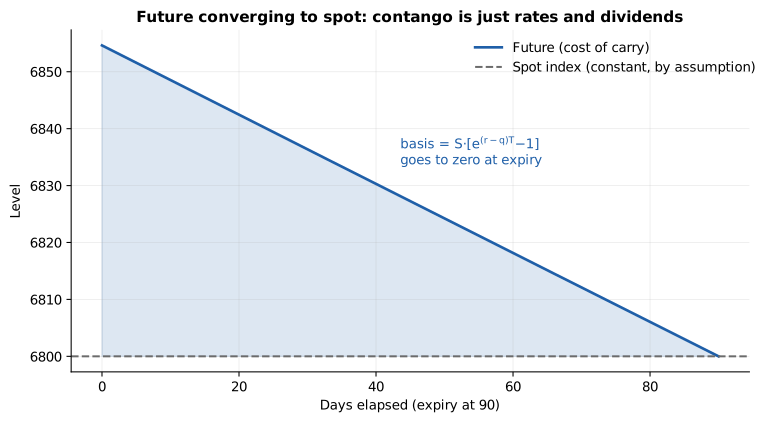
The basis is just cost of carry: with spot unchanged, the future glides toward the index as the implicit financing burns off, until they coincide at expiry.
This has two important practical consequences. First: buying and rolling index futures is economically equivalent to holding the index on leverage, implicitly paying the financing rate inside the price. You still collect the equity risk premium, because the future converges to spot at expiry and spot, in the P world, on average rises by more than the rate. Second: the future has no theta, no vega, no gamma. Its value does not decay with time and does not depend on volatility. It is a “dumb” exposure in the best sense of the word: predictable, transparent, with no second-order surprises. All the interesting complications — and all the interesting premia — live in options.
A side note on the rollover: futures expire (March, June, September, December for the ES), so a permanent exposure requires closing the expiring contract and opening the next one. The cost of the roll is usually a few ticks plus the spread, and it is already “inside” the cost of carry: it is not a hidden extra cost, as you sometimes read, but the periodic manifestation of the implicit financing rate. And one on the basis: the difference between future and index is not perfectly constant — it fluctuates with expected rates, estimated dividends and the demand for leverage of the moment. For whoever uses the future to hedge index options (the DHCS) the basis introduces a small mismatch between what you hedge and what you hedge with: negligible at the short maturities I use, but worth knowing about, because on frantic days the future can temporarily “detach” from fair value by a few points. For whoever instead holds futures in series — rolling from expiration to expiration for months — the roll also poses a measurement problem: the price history of different contracts is not a continuous series, and to compute a return over long horizons you concatenate the returns of the contracts held, never the prices. It is the accounting foundation of the CTA strategy, together with a rule of physical prudence: on commodities with delivery, the roll always happens before the first notice day (CTA trend following and The CTA bot pages). The operational mechanics of the roll — the dates that actually matter, the liquid window, the costs — have a page entirely of their own: Futures rollover.
Myths to debunk#
“Futures are riskier than stocks.” The underlying is the same: an index point is an index point. What changes is the possible leverage, not the mandatory one. An MES backed by $34,000 of cash is exactly an unleveraged investment in the S&P 500, at costs lower than or equal to any ETF. The risk lies in the ratio of notional to capital, which you decide.
“Shorting futures is a bet against the market.” It can be, but in this site’s strategies a futures short is almost always a hedge: it serves to neutralize the positive delta of a short put (the DHCS does this systematically, DHCS page). Selling a future against a position that profits when the market rises is not a bet: it is the removal of a bet.
“Contango erodes returns.” True for VIX futures and many commodities, where rolling along a curve in contango is structurally expensive (it is why buy-and-hold long volatility products bleed value, and conversely why shorting VIX futures was for years a VRP harvester — until it blew up: the XIV case of February 2018, which you will meet on the Tail risk page). For equity index futures, by contrast, contango reflects only rates and dividends: no mysterious erosion.
The role of futures in the site’s strategies#
Let me recap the four uses you will encounter later, so that when you meet them they will feel familiar.
Delta-hedging (DHCS). A short put has positive delta: if the index rises it gains, if it falls it loses, like a fraction of a long index position. By selling futures for a notional equal to the position’s delta, the directional component cancels out and only the volatility exposure remains: short gamma, long theta, short vega. But the delta changes continuously (that is precisely the gamma), so the hedge has to be recalculated and adjusted — in the version I use, once a day at the end of the session. The MES, with its $5-per-point granularity, allows fine adjustments that would be coarse with the ES.
Night sentinel (TRPS). The 1DTE puts sold at the close spend the night without stops: stops on SPX options do not operate outside regular hours, while the ES future trades almost uninterruptedly. On this asymmetry the bot’s overnight watch is built (The TRPS bot page): the ES level acts as the trigger for the conditional buyback of the put, or directly hosts native ES/MES stops that mount a static hedge when triggered. And if every automation were to fail, the ES remains the only liquid instrument for cutting delta at three in the morning from the phone app: the emergency room is open 23 hours a day.
Efficient exposure for the base portfolio. I anticipate a theme from the Capital efficiency page: whoever wants to build the “productive” portfolio on which to rest the option selling can use futures in place of part of the ETFs, freeing up cash to keep in T-bills. It is the logic of return stacking: same exposure, less capital tied up, more margin available for the options overlay.
Engine of the CTA strategy. In the site’s third strategy the future neither hedges nor stands guard: it is the position. The bot buys the futures that are rising and sells those that are falling, across fifteen or so markets in six sectors, holding them on margin on top of the rest of the portfolio — the same stacking logic as the previous point, applied to a new premium (CTA trend following page).
The future by itself, bought and forgotten, generates no premium that is not already the ERP of the underlying; a new premium can however arise from how it is held — the case of trend following, which extracts a behavioral premium from futures without touching an option. To find a premium in the very shape of the instrument, you have to move instead to the one that has a price because it has a shape: the option. That is the subject of the next page (Options), where you will find the vocabulary — strike, expiry, greeks, implied volatility — you will need for harvesting the VRP.