


Volatility risk premium#
Here we are at the protagonist. The volatility risk premium (VRP) is the systematic gap between the volatility implied in option prices and the volatility the underlying then actually realizes. In the language of the Derivatives page: it is the distance between the Q world and the P world, measured on variance. In the insurer’s language: it is the difference between the premium collected and the average claim paid out. If it is positive and persistent, selling options is a trade with positive expectancy. This page gathers the evidence, explains the causes and — above all — makes clear exactly what the premium is the price of.
The empirical evidence#
The simplest test compares the VIX (the 30-day IV of SPX options) with the volatility the index realizes over the following 21 trading days. From 1990 to today (and from 1986 using the VXO for the earlier years), implied volatility has averaged around 19-20 points, realized around 15-16: a gap of 3-4 volatility points that has persisted for nearly forty years, through bubbles, crises and opposite rate regimes. The TRPS reference track record publishes and updates this comparison every year: even in 2025, despite the April spike, realized stayed roughly 3 points below implied. Most of the time the insurance costs more than it pays back; the exceptions — the periods when realized exceeds implied — coincide with the crashes, that is, exactly the moments when the insurer pays the claims.
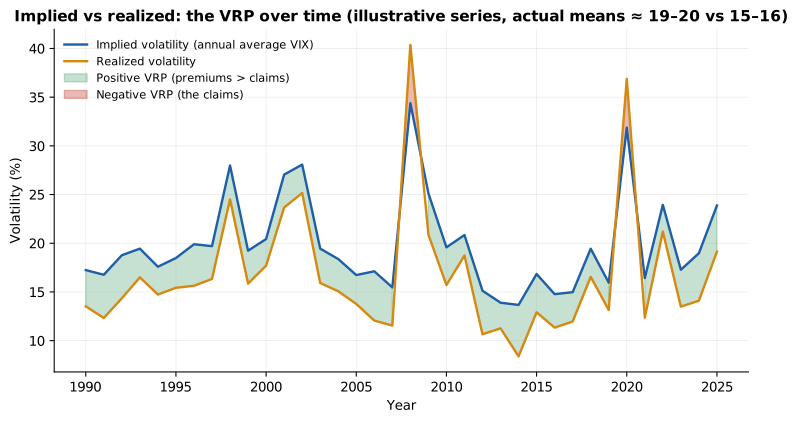
The green band is the VRP the seller collects year after year; the red stripes (2008, 2020) are the claims. Illustrative series built on the actual historical averages (roughly 19-20 implied vs 15-16 realized).
On variance the phenomenon shows up even more cleanly. The variance risk premium literature (Carr-Wu, Bondarenko) finds that realized variance is on average 20-30% below the variance implied in one-month prices. And the number that matters most to us, from the paper on 1DTE option returns that is the academic foundation of the TRPS strategy: on one-day maturities, over 2012-2023, the realized variance risk premium was −26% (statistically overwhelming, with a t-statistic around 17). Not only does the premium exist at the shortest maturities: it is the same size as the monthly one, but collectible 252 times a year.
There is a technical detail of the one-day world worth understanding, because it explains the power (and the danger) of short maturities. The price of a deep OTM put depends on the probability of a tail event. Over very short horizons, the probability density in the tails is extremely sensitive to the volatility used to compute it: the probability of a −5% move in one day computed with vol at 20% is dozens of times higher than the one computed with vol at 17.5%. The result: even a modest VRP in vol points translates, on 1-day OTM puts, into devastating expected returns for the buyer — the paper cited shows expected returns close to −100% for 5% OTM puts in a low-volatility regime. Whoever sells them collects the mirror image of that number. The Q probabilities of a crash that the option chain prices every evening are enormously higher than the P frequencies: the 1DTE seller sells exactly that gap.
Finally, the returns perspective: Bates (2021) documents that selling delta-hedged puts on the S&P 500 produced, from 1988 to 2017, Sharpe ratios 2.8 to 3.7 times that of the equity market — an anomaly so large that it constitutes, together with the results of Constantinides and coauthors on the “index option returns puzzle”, one of the open riddles of academic finance. Short-dated OTM puts turn out to be “overpriced” even after controlling for crisis factors (price jumps, volatility jumps, liquidity): roughly a quarter of the anomalous return remains unexplained by the models.
Why the premium exists#
A premium this large and this well documented should be arbitraged away. It is not, for three mutually reinforcing reasons.
First: it is compensation for a real risk, one that materializes at the worst possible times. A short volatility position loses exactly when the market crashes, unemployment rises and marginal wealth is worth more. In the language of the pricing kernel: the payoff covaries negatively with the bad states of the world, and any asset with this property must offer a premium in equilibrium — the same logic that underpins the equity risk premium. In this sense the VRP is not an inefficiency: it is the ERP’s close cousin, harvested with a different instrument. Put-call parity makes the link explicit: as seen on the Options page, E[short put] = E[equity premium] − E[long call]; and since the long call — a lottery ticket with limited loss and the positive skewness the public adores — trades at a premium and returns little or nothing on average, the short put must return more than equities. Ilmanen gave this pattern the name it deserves: markets pay those who sell insurance and those who sell lotteries, and charge those who buy them. Not despite market efficiency: because of it.
Second: the demand for protection is structurally one-sided. The institutional world is long equities to the tune of trillions, and a sizable part of it — pension funds, insurers, funds with risk constraints — systematically buys index puts, by regulation or by mandate. On the other side there is no mirror-image demand to sell: the supply comes from market makers and arbitrageurs with limited capital and strong aversion to tail risk. Bollen and Whaley showed that net buying pressure deforms the IV surface (it is the skew from the Options page); Garleanu, Pedersen and Poteshman formalized demand-based option pricing: when intermediaries cannot hedge perfectly, unbalanced demand translates into price. Here lies the conceptual difference from the ERP that it is honest to acknowledge: equities are in positive net supply (the aggregate risk of firms must be held by someone), options are in zero net supply. In theory an options market could exist with zero VRP, if protection demand and speculative demand balanced out. The VRP exists because they do not: it is the price required for the supply of insurance to exist, given structurally excess demand. Without that premium no rational seller would take the other side, and the market would empty out. It is the precise formulation of the ERP/TRP/VRP analogy I anticipated on the introductory page.
Third: harvesting it is uncomfortable. The return profile — many small gains, rare and violent losses, negative skewness, margin calls at the worst moments — is psychologically and institutionally repellent. A manager harvesting VRP can underperform for years against the colleague who buys Nvidia, and then explain a 15% loss in one week to the risk committee. Capital, mandate and career constraints keep the supply of insurance scarce, and scarcity keeps the price high. As you will see on the Edge page, it is also the reason why a patient retail investor, with no risk committee and no quarterly benchmark, holds a rare comparative advantage here. Robert Litterman explains it well in the video Who Should Hedge Tail Risk? (CFA Institute video, 2013), which you will find in the Resources.
The premium across regimes: a tariff that adapts#
One last empirical property, decisive for strategy design: the VRP is not uniform over time, and its dynamics are exactly the right kind. In absolute terms (volatility points, dollars of premium) the gap between implied and realized grows with the level of volatility: after a crash, with the VIX at 40-60, the tariffs turn hysterical and the collectible premium per unit of notional multiplies — the months following the big spikes are historically the most profitable of the trade, because implied stays high while realized comes back down first. In relative terms the premium exists in almost every regime, but with systematic exceptions: in genuine crashes realized exceeds implied for weeks (the realized VRP turns negative: those are the claims), and in extreme calm the dollar premium thins out until the bother becomes questionable. The operational consequence, which you will find identical in both strategies of the Strategies section: selling rules must be conditioned on the regime — strikes and premiums anchored to current IV, not to fixed distances — so that the position adapts on its own to the day’s tariff. The VRP is an insurance premium, and no sane insurer quotes the same policy in sunshine and with a hurricane approaching.
What the premium is the price of#
I would be a poor insurer if I closed without the claims column. The VRP is not free money: it is compensation for carrying three precise risks. Tail risk: the rare event that turns years of premiums into a concentrated loss (Tail risk page). Path risk: even without a final crash, a volatility spike inflicts immediate mark-to-market losses through vega, and can force an exit at the worst prices. And peso risk: the possibility that the premium measured in historical data is partly a statistical illusion, compensation for a disaster that has not (yet) appeared in the sample — Constantinides’s unexplained quarter could be exactly this. Whoever sells volatility must also price the event they have never seen.
And the premium is not a constant of nature: it compresses when too much capital chases it. Bates notes the deterioration of delta-hedged returns after 2018; the fifteen-year TRPS track record shows annual alpha falling from 10%-plus in the early years to the current 4.5-5% (partly by prudential choice, partly because unit premiums, for the same risk, have thinned out). The VRP should be treated like any insurance premium: monitored (the IV/RV comparison is the thermometer), and collected only as long as the tariff pays for the risk.
One practical question remains: with what capital? Selling insurance requires reserves, and idle reserves carry an opportunity cost. The next page (Capital efficiency) shows how margin architecture makes it possible to harvest the VRP on top of a portfolio that already harvests ERP and TRP — giving up nothing, but without cheating on leverage either.