


RISK MANAGEMENT#
If the Derivatives section explained why selling volatility pays, this section explains why most people who try it eventually stop getting paid. The history of short vol is a well-documented graveyard, and it’s worth pausing at the three main headstones, because each teaches a different lesson. XIV (February 2018): an ETN that sold VIX futures at constant leverage lost 95% in a single session — not because the VRP had vanished, but because the product’s own structure forced it to buy back volatility while it was exploding, in a market that knew its obligation; lesson: structural risk can kill you even when the thesis is right. OptionSellers.com (November 2018): a manager selling naked calls on natural gas for retail clients, at dizzying leverage on an underlying capable of doubling in days; a squeeze wiped out the accounts and left them owing money to the broker, apology video included; lesson: no premium justifies a position whose tail exceeds your capital. UBS Yield Enhancement Strategy (2018-2019): “defined-risk” iron condors in wealthy clients’ accounts, sunk not by a black swan but by an ordinary jittery market, because the sheer quantity of structures sold had rebuilt the very tail the wings were buying; lesson: risk that is defined per contract is not defined per portfolio. Let me unpack the UBS case: the condor’s wings protect one contract, but they cost premium, so each condor earns little. To hit the return promised to clients, UBS sold an enormous number of contracts. And here the bill comes back to the sender: if you have a “defined” but small risk on each structure, and you stack up a huge quantity of them, the sum of many small risks becomes a catastrophic portfolio loss all over again — the same “tail” (the exposure to a violent crash) that each individual wing had eliminated. In practice, volume rebuilt precisely the risk the structure promised to remove (a fundamental concept in position sizing). In no case was the thesis the mistake — the VRP existed and still exists. The mistake was always the same, in three variants: too much notional relative to capital, instruments with too much residual convexity, no plan for the day the market presents the bill. Risk management is not the prudent appendix to the strategy: it is the strategy. The edge determines how much you earn on average; risk management determines whether you’ll still be around to collect the average.
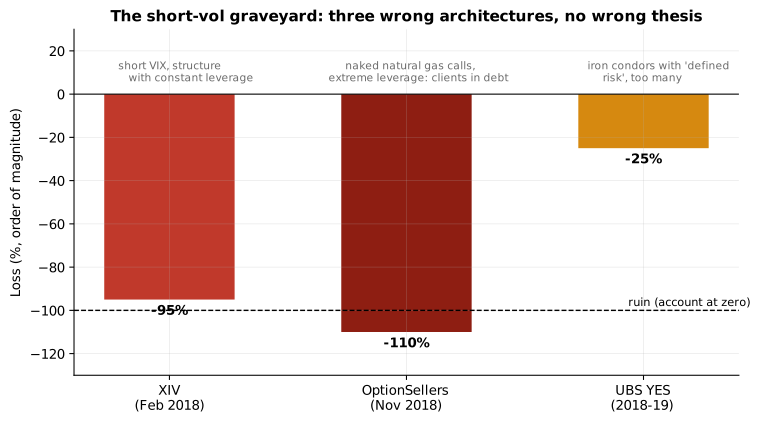
Three disasters, three flawed architectures, no flawed thesis: structural leverage (XIV), extreme discretionary leverage (OptionSellers), accumulation of “defined” risk (UBS YES). Losses are indicative.
Risk is the product I sell#
I start from the definition, because for an option seller it is unusually concrete. For a traditional investor, risk is the dispersion of outcomes around the expected value, commonly called volatility. For an option seller, risk is literally the merchandise: you collect premiums in exchange for the commitment to absorb other people’s losses in adverse scenarios. You can no more “eliminate risk” than an insurer can stop being exposed to claims: without exposure there is no premium. The trade consists of three distinct activities: selecting which risk to underwrite (which strikes, which expirations, in which volatility regimes — the equivalent of an insurance company’s underwriting standards), pricing it (selling only when the rate, i.e. the IV, compensates the risk: the IV/RV monitoring from the Volatility risk premium page), and sizing it (how much exposure per unit of capital, because no rate justifies a position that a single claim can make fatal).
It’s also worth distinguishing risk from uncertainty: risk is what you can model with a distribution (daily volatility, the historical frequency of drawdowns), uncertainty is what admits no distribution (the pandemic, the tweet, the Bank of Japan at three in the morning). The metrics on the Risk measures page measure the former; the latter can only be managed with structural safety margins — low leverage, short expirations, reserves — that work even when the model is wrong. A rule I often repeat to myself, and that sums up half of this section in ten words: parameters are calibrated to risk, structure is designed for uncertainty.
The volatility seller’s risk map#
Before measuring, you need an inventory. Here are the risks specific to the trade, from the most obvious to the most underrated.
Market risk (delta). Direction: the index falls, the puts you sold appreciate. It’s the most visible risk and, paradoxically, the least dangerous, because it’s the one everybody manages. The TRPS keeps it small by construction (delta 0.003 per contract); the DHCS neutralizes it with futures.
Convexity risk (gamma). The delta that grows against you as the market moves. It explodes near the strike and near expiration: it’s the reason positions get rolled and strikes are chosen far away.
Volatility risk (vega). The options you sold reprice higher if IV rises, even with the index flat. It’s the risk that turns a scare into an immediate loss and triggers stops long before the strike. It grows with time to expiration: minimal on 1DTE, meaningful at 30 days, lethal on long expirations (it’s what killed OptionSellers: positions miles from the strike, destroyed by delta-gamma-vega without the underlying ever touching the “dangerous” levels).
Gap risk. The market reopening far from where it closed, jumping over stops and plans. It’s the specific risk of overnight positions and the true Achilles’ heel of the TRPS: stops on SPX don’t operate at night. See the Tail risk page.
Liquidity and execution risk. In flash crashes, spreads widen by orders of magnitude and market stops get filled at absurd prices (the grotesque fills documented in October 2025, which drove the TRPS to switch to stop-limits). Liquidity is a fair-weather friend.
Margin risk. The requirement that rises while the account falls, with forced liquidation as the terminal scenario. Procyclical by construction (see the Capital efficiency page).
Model risk. Historical frequencies that understate the never-seen event; the backtest that doesn’t contain 1987. It’s managed with structural humility, not with more statistics.
Operational risk. The wrong order, the connection dropping at 9:29, the bot crashing, the human error on a Monday morning. In a strategy that lives on small, repeated margins, a single operational blunder can cost a year of premiums. The defense is the same as in aviation: written procedures and checklists, because memory and judgment are the first casualties of stress. A one-page runbook — what I do if the broker rejects the order, if the internet goes down with positions open, if a stop gets filled at an absurd price, whom I call and with which emergency numbers — written on a quiet afternoon is worth more than any modeling refinement on the wrong afternoon. And for those who automate: the bot should be treated like a junior employee with access to the account — supervision, hard limits on what it can do, and a manual kill switch always within reach.
The three lines of defense#
Risk management is organized on three levels, in order of increasing importance — and it’s a counterintuitive order, because the level most discussed in forums is the least important.
Level 1: tactical defense (stops and adjustments). Stop-losses and stop-limits, early closes, emergency delta-hedging. Useful, but fragile: stops fail in exactly the scenarios they exist for (gaps, flash crashes, evaporated liquidity). The TRPS uses stops at 5-20 times the premium collected, knowing they are a friction that converts rare, large losses into small, frequent ones — not a guaranteed insurance policy. A rule of the strategy, which I adopt in full: never sell a position you couldn’t hold to expiration if the stop failed.
Level 2: structural defense (selection and construction). Short expirations that reset risk every day; strikes conditional on the volatility regime (the higher the vol, the farther out you sell); liquid strikes; time diversification of entries. This level reduces the probability of being in the wrong place, and it’s the heart of the strategies in the Strategies section.
Level 3: existential defense (sizing). Leverage and position size, chosen so that even the simultaneous failure of the first two levels is not fatal. It’s the only level that cannot fail, because it depends on neither execution nor forecasts: it’s arithmetic decided in advance, with markets closed and a cool head — which is exactly why it works when everything else doesn’t. The Ergodicity page will give it theoretical grounding through ergodicity; for now, the folk version will do: you can survive a 30% loss, not a 100% loss, and the difference between the two is made not by the market but by the notional you chose yourself through leverage.
How this section is organized#
The four pages that follow develop four questions. The Risk measures page asks: how do you measure the risk of a strategy that lies to standard metrics by construction? You’ll see why volatility, Sharpe and the Information Ratio systematically flatter short vol, and which tail measures (CVaR, stress-test loss, Israelov’s STAR) tell the truth. The Tail risk page asks: what do market tails really look like? Fat tails, jumps, the chronicle of disasters, what the data say about advance warning (there almost always is some) and about the exceptions (they exist). The Ergodicity page asks the fundamental question: why can a strategy with positive expectation still ruin you, and what leverage makes the time average equal the ensemble average? It’s the most philosophical page on the site and, not coincidentally, the one from which all the sizing numbers in the Strategies section descend. And the Kelly criterion page closes with the practical question: how many contracts, at what leverage, at what probability of halving — the ergodicity principle turned into numbers, on a concrete put-selling case.
One last warning before diving into the details. The hurried reader might conclude that so much caution makes the game barely profitable. The opposite is true, and I prove it with Israelov’s numbers: the alpha of a short vol strategy scales linearly with the extreme-loss budget you accept. Return isn’t created through financial engineering: it is bought, and paid for in tail risk. Risk management is there to tell you exactly how much of it you’re buying — and to make sure you buy an amount you can survive.