


STRATEGIES#
Everything that came before converges here. By now you know what is being sold (convexity, page Options), why on average it pays (the VRP, page Volatility risk premium), which capital architecture to collect it with (the margin overlay, page Capital efficiency) and under which survival constraints (the Risk management section, summed up in the ergodic principle: size for the worst case, not the expected one). This section turns those principles into three complete operating strategies: two that sell volatility, plus a third — trend following on futures — whose trade is the opposite and which rounds out the portfolio. But before introducing them, it’s worth taking a tour of the neighborhood: volatility selling comes in many popular incarnations, and understanding why I discard almost all of them is the best way to understand why I keep these two (the bestiary does not deal with the third, which sells no volatility: it arrives at the end of the section).
The volatility selling bestiary#
Covered calls. You own the index and sell OTM calls against the position: you collect premium while giving up the upside beyond the strike. It’s the classic gateway trade, and it’s also — here I lean on Israelov, who devoted an entire paper to covered calls (Covered Calls Uncovered) — a strategy poorly understood by its own devotees. Decomposed into factors, a covered call is: equity exposure (roughly half the return), volatility selling (the good part), plus an involuntary market-timing component that rewards no one. And there’s the merchandise problem: because of the skew (page Options), OTM calls are the cheapest insurance on the board — you’re selling the convexity the market pays worst for. Israelov’s numbers: the front-month call 1 standard deviation OTM has returned, per unit of stress-test loss, roughly half the average of the entire surface. You can do much better by choosing what to sell.
Cash secured puts and the wheel. I already filed the CSP away on the Capital efficiency page: capital that works only once, VRP collected at the cost of giving up ERP and TRP. The wheel (CSP until you get assigned, then covered calls until the shares get called away, repeat) adds to the CSP a jumble of path-dependent exposures; it has earned a well-argued takedown (“Why the Wheel Strategy Doesn’t Work”, page Resources) that I fully endorse. The wheel’s appeal is narrative — “I get paid to buy shares I wanted anyway” — not financial.
Iron condors and credit spreads. Selling a strangle while buying the wings: defined max loss, reduced margin, huge retail popularity. The wings you buy, though, are themselves OTM options: you’re buying back at a steep price (because of the skew, especially the put wing) part of the premium you collect. The protection is worth its cost if you use it as a structural substitute for low leverage; it’s worth nothing as an excuse to add contracts — which is how ninety percent of the public uses it, recreating with ten “protected” condors the same tail as three naked puts. The UBS case (page Risk management) proves that even professionals manage to lose big with “defined-risk” structures. That said, the spread remains a legitimate tool for those without access to portfolio margin or who want an absolute hard cap on the overnight session: I come back to it in the TRPS parameters.
Variance swaps and short VIX. The “pure” way to sell variance, without picking strikes. But a replicated variance swap is a portfolio of options weighted 1/K²: it structurally overweights precisely the deep OTM puts that (as you’ll see in a moment) are the worst paid per unit of stress. And packaged short-VIX products carry structural risk on top: XIV (page Risk management) didn’t die because of the VRP, it died from rebalancing its own leverage into a runaway market. Tools for professionals with professional balance sheets.
Income ETFs (JEPI and family). Convenient outsourcing, but the near totality of option-selling ETFs have zero or negative alpha versus a simple index/T-bill blend, with Sharpe ratios below the index; fees eat away a premium that, packaged in passive wrapping, was already thin. At the moment no vehicle exists that replicates the strategies on this site: those who want them build them themselves.
Single-stock options. Single-name IVs are higher than the index’s, and the temptation to “sell premium on Tesla” is perennial. I resist it, for three reasons. First, most of that extra IV is honestly priced idiosyncratic risk: a single stock can drop 30% overnight on an earnings report, the index can’t — and the VRP measured on single names, net of that risk, is thinner than the index’s (idiosyncratic variance is diversifiable, so the market pays little for it). Second, you lose the entire infrastructure of the Derivatives page: American style with early exercise, physical delivery, patchy liquidity. Third, regime conditioning (the key defense of the Tail risk page) works on the index because aggregate volatility “gives warning”; a single stock gaps on its own news, with no VIX to tip you off beforehand. Selling convexity on the index is an insurance business; selling it on single names is collecting earnings reports like landmines.
The two axes of the choice: what to sell, how to hold it#
The tour of the bestiary teaches that volatility selling fails in two ways: selling the wrong convexity, or holding it the wrong way. These are two independent questions — the first is about where on the surface (strike and expiry) the premium per unit of risk is richest, the second is about the portfolio architecture around the position (hedged or not, leverage, exit rules) — and every option-selling strategy, including those in the bestiary, is a pair of answers to these two questions, whether declared or unwitting. The two short-vol strategies on this site are two coherent — and nearly opposite — answers, and both start from the same map: the return/risk surface of SPX options charted by Israelov (pages Risk measures and DHCS), which identifies short expiries as the best-paid zone outright, and then forks on the strike.
Tail risk protection selling (TRPS) sells the extreme corner of the surface: one-day puts, very far from the money, with the portfolio’s delta kept small and unhedged. It maximizes frequency (252 resets a year), psychologically sustainable carry and the Information Ratio; it pays the bill in overnight gap risk and accepts Israelov’s critique — that corner is the worst paid per unit of stress — offsetting it with the temporal defense (the daily reset that exploits the warning crashes give, page Tail risk) and with textbook ergodic leverage. It’s the frequency insurer’s strategy: a thousand small policies, renewed every evening at the updated rate.
Delta-hedged convexity selling (DHCS), modeled on Israelov’s paper, sells the center of the surface instead — roughly 30-day puts slightly OTM, exactly where STAR peaks — and neutralizes their direction with futures, rebalancing every evening. It isolates the VRP in its pure state, gives up the equity premium component by construction, and shifts the work from entry timing to hedging discipline. It’s the precision insurer’s strategy: a few large policies, with dynamic reinsurance of the directional risk.
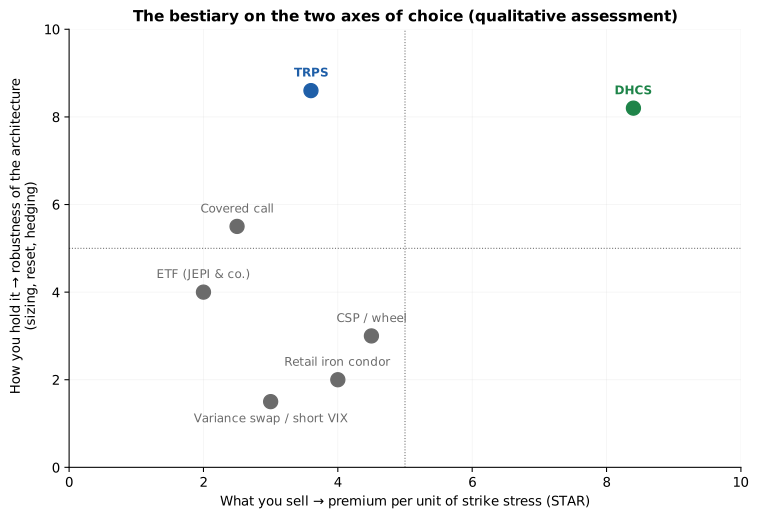
The chapter’s qualitative map: bottom left, the strategies that sell poorly paid merchandise with fragile architectures; TRPS and DHCS answer the first question in opposite ways and the second with equal seriousness.
I won’t anticipate the comparison (that’s the TRPS vs DHCS page, after you’ve seen them in detail); I’ll only anticipate the thesis: they are not competitors but complements, because they collect the same premium with nearly orthogonal path exposures — TRPS fears the night, DHCS fears the daytime vega spike; TRPS thrives in the daily grind, DHCS gets paid best in choppy regimes.
Off the map, deliberately, sits the section’s third strategy: the CTA trend following doesn’t sell convexity but replicates it, buying trends on the futures of six sectors, and so it doesn’t answer this chapter’s two questions — it answers a third one, which the two sisters on their own leave open: what to put next to a book that sells insurance, for the years when insurance has to be paid for. I discuss it after the comparison, in the two pages that close the section.
The prerequisites#
Before the operational pages, the list of what it really takes — because the difference between those who collect the VRP and those who end up in the graveyard of the Risk management page rarely lies in the parameters.
Capital and access. An account with portfolio margin ($110,000 threshold at IB), authorization to sell naked index options, real-time market data for options and indices. Without PM, the spread version is the only sensible architecture, with scaled-down expectations.
A portfolio you’re not forced to sell. The overlay rests on the collateral (page Capital efficiency): if the collateral is money you might need in six months, the cursed correlation — margin calling precisely when everything is falling — will force you to liquidate at the lows. Patient capital or nothing.
Time and temperament. Ten minutes a day, but those ten minutes, at fixed times, for years — plus the ability to execute the identical routine the day after a stop got eaten. Boredom is the hidden cost of TRPS; bookkeeping fussiness is that of DHCS. Automation (the bot) cures the boredom but introduces operational risk: no free lunches here either.
Calibrated expectations. The order of magnitude that emerges from public track records and the literature — a matter of record, not a promise: page Disclaimers — is 2-4% annual alpha on the account for the full overlay, with rare but violent drawdowns and — worth repeating — a return that adds to the portfolio’s, rather than replacing it. Two to four points may seem like little for so much apparatus; compounded over a decade on a FIRE portfolio, they are the difference between a 3.5% withdrawal rate and a 4.5% one. Anyone looking to double their money every year is on the wrong site; I simply want to raise my portfolio’s sustainable withdrawal rate by one point in a FIRE context (from a conservative 3% to 4%) for the first 10 years of FIRE.
One last foundational question remains, and it isn’t technical: by what right does an amateur with a mini PC expect to make money systematically in a market where Citadel and Jane Street operate? If the answer isn’t clear to you, every parameter that follows is built on sand. The next page (Edge) is devoted entirely to that question.