


Delta-hedged convexity selling — DHCS#
The second strategy starts from a question TRPS never asks itself: if the product for sale is convexity, why keep the delta attached to it? A sold put is a package of two exposures: a directional bet (the positive delta: you profit if the index rises) and a volatility bet (short gamma and vega, long theta: you profit if the world moves less than what was priced). The first exposure you already own, in abundance, in the collateral portfolio: that’s the ERP. The second is the reason you’re here: the VRP. Delta-hedged convexity selling surgically separates the two and keeps only the second: it sells the option and simultaneously sells futures to neutralize the delta, rebalancing the hedge every day. It’s the strategy from the Israelov and Tummala paper (Which Index Options Should You Sell?) that you’ve already met twice — for the STAR methodology on the Risk measures page and for the critique of TRPS on the TRPS page — and which here I finally assemble in full.
What to sell: the map of the surface#
The paper’s contribution is not the idea of delta-hedging (as old as Black-Scholes: it’s the “pure volatility bet” of the Options page), but the systematic answer to the question in its title: which point of the surface is worth selling? Israelov surveys SPX options by expiration (from one month to two years) and moneyness (from −2.5 to +1 standard deviations), selling all of them in delta-hedged form, and measures alpha, volatility, CVaR and stress-test loss for each. The results that steer everything:
Short expirations dominate. The bulk of the VRP lives in the first month of an option’s life: the front month’s return-to-risk ratio is a multiple of that of the long expirations, whichever metric you use. The reason is theta: decay — and hence the pace at which you collect the premium — accelerates toward expiration, while vega (the sensitivity to IV spikes, the path risk) declines. Selling long expirations means maximizing risk per unit of premium: it’s the graveyard lesson of the Risk management page, rediscovered by quantitative means.
On the strike, it depends on the yardstick — and the right yardstick is stress. Measured by IR, the deep OTM puts win (TRPS territory). Measured by STAR — alpha per unit of loss in the extreme scenario — the winners are puts ATM and out to one standard deviation OTM on the front month: STAR on the order of 19-27%, versus the relative 0.6× of the deep OTMs scaled to equal alpha. The economic logic: the ATM put collects the largest premium in absolute terms (maximum time value, Options page) while its crash loss is “only” proportional to the notional; the deep OTM collects crumbs and, levered up to produce the same alpha, blows up in the extreme scenario. For anyone who sizes on the worst case — the ergodic principle of the Ergodicity page — the ATM/−1σ zone is the best merchandise on the board.
DHCS therefore sells front-month SPX puts (about 30 days), ATM or out to one standard deviation OTM, delta-hedged with futures, rebalanced daily, rolled before expiration. Let’s look at the pieces.
The mechanics, piece by piece#
The opening. You sell the put at 25-35 days to expiration, with the strike chosen by delta (ATM ≈ −0.50; one standard deviation OTM ≈ −0.15/−0.25 depending on the vol regime; a practical compromise is the −0.25/−0.40 zone). At the same time you sell futures for a notional equal to the position’s delta: for a 0.40-delta put on one SPX contract (notional of roughly $730,000 with the index at 7,300), you need roughly $290,000 of short futures — four-and-change MES, which is why the Micro of the Futures page is the right tool: with the $340,000 ES, the rounding error would be half the hedge.
The rebalancing. The put’s delta changes with the market (that’s gamma): if the index falls, the delta of the short put position grows and the short futures no longer suffice — you sell more; if it rises, you buy some back. The frequency is a trade-off between precision and costs: the paper, and my own practice, use daily rebalancing at the end of the session, which leaves the intraday move uncovered (a cost in residual volatility, not in expectation: unhedged intraday gamma is zero-mean noise, as long as it stays small) but keeps transaction costs negligible with MES. Rebalancing on a delta threshold (e.g. every 0.05 of drift) is the equivalent alternative for those who automate.
The roll. At 7-10 days to expiration the position is closed and a new one is opened in the following month, before gamma explodes (Options page): the last week of an ATM option’s life is the zone where daily delta-hedging becomes a chase after a delta that changes faster than you can follow it, and where hedging costs eat the residual theta. DHCS deliberately gives up the final stretch of decay — the richest but the wildest — which is exactly the stretch where TRPS lives. The two strategies split the option’s life between them: DHCS takes the first twenty days, TRPS the last one.
What remains after the hedge. Not zero risk: the VRP in its pure state, with risks of its own. Gamma remains (the daily P&L is ≈ theta collected − ½·gamma·(ΔS)²: you win on the days the index moves less than the implied vol you were paid for, you lose on the days it moves more — the naked IV-versus-RV bet of the Volatility risk premium page). One number to fix the order of magnitude: with IV at 16%, the daily “break-even” is an index move of about 1% (16%/√252); on days when the index moves 0.4% theta wins comfortably, on a ±2% day the gamma term costs about four times the break-even and the day is in the red. Vega remains: an IV spike marks up the sold put and inflicts mark-to-market losses even with the delta perfectly hedged; at 30 days to expiration the vega is substantial, and it is DHCS’s signature risk the way the overnight gap is TRPS’s. And a thin directional residue remains, which the paper calls the implicit beta problem: since IV and the index move in opposite directions (the index falls → vol rises → the sold put loses twice), a delta-neutral position in the Black-Scholes sense retains a small positive beta equal to vega·∂IV/∂S. Purists correct it by hedging a few points of delta beyond the nominal; pragmatists accept it as a known friction.
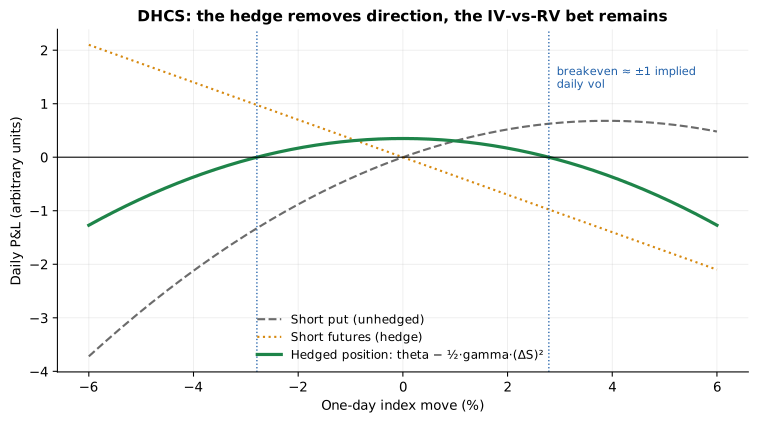
The sum of the parts: the sold put (gray) plus the short futures (orange) gives the green bell — theta banked if the index moves less than implied vol, a symmetric loss if it moves more. Direction has vanished.
Sizing: the stress budget#
Sizing follows the method of the Risk measures page, which here becomes operational. You fix the extreme-scenario loss budget first — say: in an October 1987-type crash repeated tomorrow, I accept losing at most 20% of the account — and work backwards to the sellable put notional: with the front-month −1σ delta-hedged put, the stressed loss is around 10% of notional (the paper’s numbers), so a 20% budget funds a notional of about 2 times the account. Israelov’s linear corollary closes the circle: that budget corresponds, on the best zone of the surface, to alpha on the order of 4.5% a year in the paper’s historical data — which happens to be the same magnitude as TRPS at steady state, reached from the opposite direction. That is no coincidence: it’s the market rate for tail risk, and it doesn’t change based on how you package it. Whoever wants more alpha buys more stress, linearly, and knows it in advance: I find it the intellectually most honest way to choose one’s leverage.
Weak points, no sugarcoating#
The vega spike. A VIX that doubles in three days (February 2018, August 2024) produces immediate, deep drawdowns even without the index actually crashing: DHCS suffers during the storm, not just in the shipwreck. In compensation, it’s precisely after the spike that the strategy collects best: you sell puts at hysterical rates while realized comes back down — the post-crash months are historically the VRP’s best.
Hedge tracking. Overnight gaps between rebalances, basis between the future and the index, MES rounding: neutrality is always approximate, and on ±3% days the approximation makes itself felt. It’s manageable noise, but anyone expecting a flat equity line will be disappointed.
Costs and fussiness. Two to four MES adjustments a week, one roll a month, the delta bookkeeping every evening: the hard costs are small (MES spread + commissions), the real cost is the daily accounting discipline — DHCS forgives improvisation less than TRPS does, and it’s the second natural candidate for automation (the second of the three bots from the introduction).
The comparison with the variance swap closes the discussion opened on the Strategies page: selling “pure” variance via swap or short VIX amounts to selling the entire surface with 1/K² weights, i.e. overweighting the deep OTMs worst paid for stress. DHCS is, in essence, an artisanal, selective variance swap: same family, but you sell only the point of the curve where you get paid best. Bates (Volatility risk premium page) certifies the family: the Sharpe of delta-hedged put selling at 2.8-3.7 times the market over thirty years.
Parameter recap (plausible ranges): expiration of 25-35 days, roll at 7-10 days out; strike by delta, −0.25/−0.50; hedge with MES, daily EOD rebalancing or at a 0.05 delta threshold; sizing by stress budget (10-25% of the account), which with the paper’s numbers implies a notional of 1-2.5x the account; no stop on the underlying (the delta is hedged), an optional vega/IV stop for cautious temperaments.
Two strategies, then: same mine, opposite tunnels. One sells the remote corner of the surface and keeps the delta; the other sells the center and neutralizes it. One fears the night, the other the barometer. Which to choose — or in what proportion to hold both — is the site’s final page.