


Edge#
Edge is an overused word, so let me start from the definition I work with: an edge is a positive expectation that survives costs, risk and competition, and whose source you can explain. The last clause is the most important: a positive expectation whose origin you don’t know is indistinguishable from luck, and above all you can’t know when it stops existing — whoever makes money without knowing why will sooner or later lose money without knowing why. This page answers three questions in sequence: where the volatility selling edge comes from; why the professionals leave it to us; how to verify that it’s still alive.
The three sources of an edge (and where mine sits)#
Sustainable edges belong to three families, and it’s worth knowing all of them because every strategy you’ll ever meet belongs to one of them (or to none, which is the most frequent answer). The first is the risk premium: you get paid to carry a risk that others want to shed — it’s the most solid source, because it doesn’t require anyone to be wrong: it only requires preferences to be heterogeneous. The second is behavioral: you exploit other people’s systematic errors (the love of lotteries, panic, extrapolation). The third is structural: you exploit other people’s constraints — mandates, regulations, capital limits — that force someone to trade at uneconomic prices.
The strength of the VRP, argued on the Volatility risk premium page, is that it draws on all three. It’s a risk premium: a short volatility position loses in the worst states of the world, and equilibrium has to pay for that — put-call parity shows it must return at least as much as equities. It’s behavioral: the public pays premium for lottery-like payoffs (OTM calls) and for emotional insurance (puts after crashes), Ilmanen’s insurance/lottery framework. And it’s structural: institutional demand for protection is mandatory and one-sided, supply is limited by intermediaries’ capital (Garleanu-Pedersen-Poteshman), and the price picks up the difference. Three independent roots make the edge robust: even if markets became perfectly rational tomorrow, roots one and three would still stand. It’s a test I apply to every strategy I come across: how many of the three sources hold it up, and how many would survive the disappearance of the suckers?
“Why doesn’t Citadel take it all?”#
It’s the objection I get most often, and the answer deserves to be built carefully because it contains the correct mental model of the whole business. The objection assumes that retail and the market maker are competitors in the same zero-sum game: if there’s a profit on the table, the fastest and best-capitalized player grabs it first and in full. For speed edges (arbitrage, market making in the strict sense) that’s exactly right, and it’s why you’ll find nothing on this site that resembles an arbitrage: on that turf retail isn’t disadvantaged, it’s simply absent — the bid-ask spread you pay on every order is the toll you hand over, once and for all, to the winners of that race. But the VRP is not a profit to be grabbed: it’s a risk to be held. And the capacity to hold risk doesn’t scale with server speed: it scales with capital willing to bear losses at the worst possible times — which is the scarcest and most expensive resource in finance.
The right model, as I anticipated in the introduction, is reinsurance. The market maker is the ceding company: by mandate it has to quote and absorb the flow of institutional put buying, accumulating in inventory a tail risk that its balance sheet (and its risk manager) tolerates only up to a point. Beyond that point it prefers to pass on risk and premium together: it raises prices (the skew is this too) and lets others — hedge funds, smaller prop shops, and ultimately the retail seller — underwrite the slice of risk it doesn’t want to keep. When I sell a put I’m not beating Citadel on speed: I’m buying from Citadel, at the price Citadel itself has marked up, a risk Citadel is happy not to have on its books. I’m a supplier in its value chain, not its competitor; my existence suits it, and the confirmation is that the flow has never dried up in forty years. Garleanu and coauthors found that market makers are structurally net sellers of index puts against a public that is structurally a net buyer: the whole industry is a conveyor belt of tail risk running down from pension funds toward whoever has the capital and the stomach to hold it. I position myself at the end of the belt.
Then there’s a second, subtler layer to the answer: on this specific segment the small player has genuine comparative advantages. No risk committee forcing positions closed after a bad quarter (career risk is the great compressor of the institutional supply of insurance: a fund that loses 15% in a month suffers redemptions and firings even if the strategy is sound, and managers know it and steer clear); no capacity problem (TRPS moves millions in notional a day in a market that trades hundreds of billions: invisible, whereas a ten-billion fund couldn’t replicate it without moving prices — one of the rare cases where being small is a technical advantage, not a consolation prize); unlimited horizon and own capital, which is exactly the kind of capital that can afford to collect the behavioral illiquidity premium. The retail edge isn’t informational: it’s institutional. We get paid for not having a boss.
Edge is measured: alpha, not anecdotes#
A claimed edge must be put to statistical verification, and the VRP passes it with rare margins. The standard test is regressing the strategy’s returns on market factors: the edge is the intercept (the alpha) that survives after stripping out what passive exposures can explain — if your returns were just equity beta in disguise, the intercept would be zero and you’d be better off with an ETF. The TRPS reference track record includes this verification: regressing the put selling returns on the S&P 500, on the CBOE PUT index and on a kitchen sink of seven factors (bonds, gold, Fama-French styles), the alpha stays around 7% a year with a t-statistic close to 7 — overwhelming significance — and economically negligible betas. On the academic side, Bates and Constantinides (page Volatility risk premium) tell the same story over horizons of decades. Two mandatory caveats, which by now you can recite along with me: statistical alpha can’t distinguish skill from the premium for a risk not included in the factors (and here we know it’s largely the latter: tail compensation); and significance in samples without catastrophes is always, in part, a model problem.
The edge decays, and must be watched#
No premium is a constant of nature. Risk premia compress when too much capital chases them: more insurance supply, lower rates — the same dynamic as the ERP when valuations rise. The signals are already in the data: Bates documents the deterioration of delta-hedged put selling after 2018; the fifteen-year TRPS track record shows alpha down from 10%+ in the first decade to the current 4.5-5% (partly voluntary de-risking, partly thinner unit premiums: the target premium went from 50 to 15 cents while the index doubled). The explosion of 0DTEs since 2022 — today roughly half of total SPX option volume — has brought to the short expiries volumes and sellers that didn’t exist ten years ago. The direction is clear, and honesty demands planning on current numbers, not 2012’s.
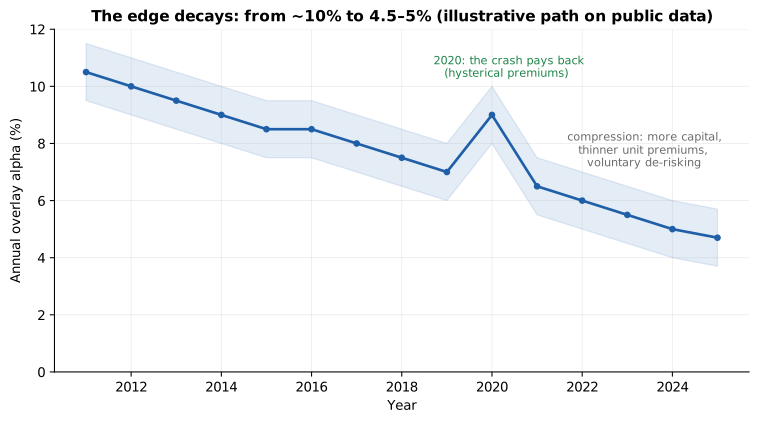
The edge compresses: illustrative path of the overlay’s alpha over the decade, reconstructed from the numbers of the public reference track record (page Resources). The 2020 peak is the crash that pays back: hysterical rates for months. The good news, symmetrically: the ultimate source of the premium — institutional demand for protection — grows with the wealth to be insured, and every crash purifies the field, sweeping away the oversized sellers and bringing rates back to generous levels. The VRP compresses in cycles, but so far it has always come back: not because it’s magic, but because fear can’t be arbitraged away.
Hence the surveillance discipline: the edge is monitored at the source, not on the P&L. The thermometer is the continuous IV versus RV comparison (page Volatility risk premium): as long as average implied exceeds average realized by 3-4 points — as it has without interruption, 2025 included — the rate pays for the risk and the business is open. And it’s worth fixing the abandonment criterion in advance, because deciding it during a drawdown is impossible: I would quit if the average IV−RV spread stayed below 1-1.5 points for more than a year outside a crash regime, or if the five-year regression alpha lost significance. An edge without a falsification criterion is not a thesis: it’s a faith. The day that gap disappeared for good, no past track record would justify carrying on. And remember that the realized VRP periodically turns negative in crashes: that’s not the death of the edge, it’s the edge paying out claims — the difference shows up precisely in the thermometer, which after every crash reads higher rates than ever.
I’ll close with the synthesis that ties this page to everything else. The volatility selling edge is real, triply grounded, statistically verified and accessible to retail for structural reasons, not because of other people’s naivety. But it is an edge denominated in tail risk: you collect it in small certain installments and pay for it in rare enormous ones, and the balance is positive only for those who stay solvent long enough to collect the average (the theorem of the Ergodicity page). The two pages that follow show my two preferred ways of organizing exactly this: same source of profit, two opposite architectures of survival.