


TRPS vs DHCS#
You’ve made it to the end, and I can finally set the two strategies side by side. An honest premise: there is no winner, and anyone selling you one hasn’t understood the problem. TRPS and DHCS draw from the same source — the VRP of the Volatility risk premium page — but they collect it with almost opposite architectures, and the choice depends on which risk you’d rather carry, which routine you’re able to sustain, and what’s in the rest of your portfolio. I’ll proceed by comparisons, then give my synthesis.
What they actually harvest#
The deepest difference is not operational but one of factor composition. TRPS sells puts unhedged: every position is a package of VRP + a thread of ERP (the 0.003 delta is small, but multiplied by 3-4x leverage and added to the equity collateral, on bad days the strategy is a relative of the market: its losses arrive when the index’s do). DHCS neutralizes the delta and delivers VRP in its pure state: its P&L is the IV-versus-RV bet, nearly uncorrelated with direction — it loses in choppy markets, not in falling markets, and the distinction is not pedantic: a slow, orderly 2022 (index −19%, but realized below implied for long stretches) is a mediocre year for the collateral and a respectable one for DHCS, while an August 2024 (index nearly flat by month-end, VIX exploding in the middle) wounds it and leaves almost unscathed a TRPS whose strikes had fled in time. Same mine, orthogonal path sensitivities.
The metrics: each wins on its own turf#
The duel from the Risk measures and DHCS pages, recapped. On the Information Ratio, TRPS has no rival: one-day deep OTMs have the highest alpha-to-volatility ratio on the surface (Israelov’s 2.5 versus 0.7; the double-digit IRs of the reference TRPS track record), because the characteristic loss almost never shows up in the sample. On STAR, DHCS wins, and that is its entire manifesto: alpha per unit of extreme-scenario loss is highest in the ATM/−1σ zone, with the corollary that at the same accepted stress DHCS extracts more premium. The mature reading, with the hindsight of the Risk measures page: the IR measures the quality of the path, STAR the price of the tail. TRPS buys a wonderful path paying in unrealized tail; DHCS buys a contained tail paying in a bumpy path (visible vega drawdowns, losing months as a matter of course). Your monthly statement will look better with TRPS; your 1987 scenario will look better with DHCS.
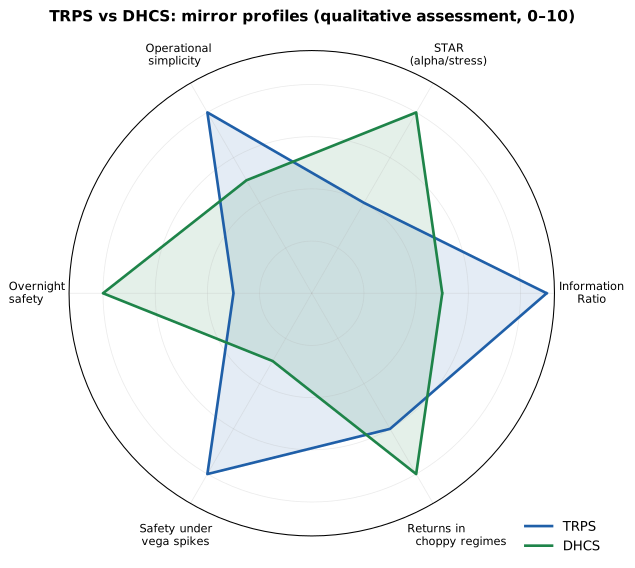
The two strategies’ mirror-image profiles across six dimensions (a qualitative assessment): where one is strong, the other is fragile — the visual argument for complementarity.
There is, though, the counter-argument from TRPS’s defenders that deserves one last round: the unconditional stress test overstates TRPS’s risk, because its strikes recalibrate every evening to the vol regime — the relevant scenario isn’t “−20% from here” but “−20% with no warning at all”, historically much rarer (the matrix of the Tail risk page). It’s true, and it halves the distance. It doesn’t erase it: the gap truly without warning — the BoJ night, the Peso of the Tail risk page — is exactly the unexplained quarter the market keeps paying for. The synthesis I propose: daily conditioning makes TRPS much safer than the static stress test says, and less safe than its IR says. The truth lives in the middle, and its name is 3-4x leverage.
The signature risks, mirrored#
Every strategy has its personal monster, and the two monsters almost never meet. The TRPS’s monster is the night: the opening gap beyond the strikes with the daytime stops switched off — rare, conditional, but at 3-4x leverage worth a −30/40% when it arrives. Since the bot began standing the night guard (The TRPS bot page), the monster finds a sentinel on the servers: a conditional buyback or a static futures hedge that work in continuous declines — but a static guardian is no exorcism, and the instantaneous jump beyond the trigger remains its exclusive domain. The DHCS’s monster is the barometer: the vega spike that inflicts the drawdown while the market shakes, with the psychological aggravation of losing on a “hedged” position. Mirror-like, each sleeps where the other keeps watch: DHCS spends the night nearly neutral (the delta is hedged, and a 30-day option’s overnight gamma is modest); TRPS crosses the daytime vol spikes with a tiny vega and strikes that by the next day have already been recalibrated. Even the calendar of profits is mirrored: TRPS thrives in the calm and collects its best in the months after a crash (2x rates on a VIX at 60: March 2020 was the reference track record’s record month); DHCS does best in medium-to-high, falling vol regimes, and gets boring in the long calms where the ATM premium thins out.
Operations and capital#
Routine. TRPS: ten minutes at rigid times (the end-of-session window plus the check at the open), 252 days a year, zero interim bookkeeping — boredom as the main cost. DHCS: the evening delta ritual, two to four MES adjustments a week, one roll a month — fussiness as the main cost. Both are automatable; TRPS is simpler to write (a state machine with four events a day), DHCS more fault-tolerant (missing a rebalance is a nuisance, missing a stop is not).
Capital and margin. Both want portfolio margin (Capital efficiency page) and patient collateral. TRPS consumes more margin relative to its alpha on turbulent days (PM stresses the levered notional); DHCS enjoys more stable margin because the short future offsets the put in the model’s scenarios. Below PM’s $110k: TRPS in the spread version, or DHCS in miniature with MES — the only one of the two that degrades gracefully on small accounts.
Together, not instead#
And here is the conclusion I’ve been driving toward since the Strategies page: because the monsters are different, the calendars mirrored and the source shared, the two strategies combine better than either stands on its own. An overlay that dedicates part of the risk budget to TRPS (the frequency engine, the IR, the daily carry) and part to DHCS (the stress anchor, the pure VRP, the returns in choppy regimes) collects the same premium with a smoother path and a shorter tail than either pure version: the diversification you can’t find across assets you find again across architectures. The proportion is a matter of taste; my compass is the single stress budget of the Ergodicity page: I fix the maximum tolerable loss in the joint extreme scenario (overnight gap + vega spike, because the truly bad day brings both), and within that budget I weight TRPS more the more defensive my collateral is, and DHCS more the more I’m already loaded with equity beta. To those who ask me for a single answer I can only recount my own order: I started with TRPS, because my problem was adding return to a prudent portfolio with the minimum of daily effort; DHCS came later, when the problem became harvesting VRP without adding a gram of beta to an already equity-heavy portfolio. Over time, I ended up keeping both. And the reasoning, once begun, didn’t stop at two: if two architectures on the same premium complete each other, a strategy on a different premium — one that earns precisely in the scenarios where volatility selling suffers — completes the portfolio at a higher level. That is the third leg of the CTA trend following and The third leg pages.
Where to start#
One practical note before the farewell, because the question always comes: in what order did I learn all this? The progression I followed (with more mistakes than I readily admit) has four stages. First, paper: six months of simulated execution of the chosen strategy, not to verify the edge — other people’s backtests suffice — but to discover one’s own operational errors while they cost nothing. Second, minimal real size: a single SPX contract at leverage below 1, because paper doesn’t teach the emotion of a stop eaten with real money. Third, gradual scaling toward the steady-state leverage, raising it half a point at a time and only after coming through — operationally and psychologically — a few episodes of real volatility unscathed. Fourth, automation, only of what has already been done by hand for months: the bot codifies a discipline, it doesn’t replace it. At every stage, the dashboard of the Risk measures page and the ergodic test of Ergodicity stay the same: the size changes, never the method.
Farewell#
This is the chapter where the conceptual circle closes, and it closes where it began: with the insurer analogy. You’ve seen that the premium exists and is the price of a real service (Volatility risk premium), that it can be collected without giving up the portfolio’s other premiums (Capital efficiency), that flattering metrics must be read with an actuary’s suspicion (Risk measures), that the tails are fat but almost always knock before they enter (Tail risk), and that the only difference between an annuity and a ruin with the exact same expectation is one number — leverage — chosen at the desk before the market opens (Ergodicity). The two short-vol strategies are nothing but two ways of organizing this truth: TRPS entrusts it to frequency and the reset, DHCS to the hedge and the stress budget.
The VRP, in the end, is the premium the market pays those willing to stay awake while everyone else wants to sleep soundly. It’s collected 15 cents at a time and defended with arithmetic, not heroism. If you take one sentence away from these pages, let it be the rule I set to govern all the others: every position is sized as if the stop were going to fail tonight — night guard included — because one night, in a year nobody knows in advance, it will, and everything earned until then will depend on how much one had decided one could afford to lose.
The circle of volatility selling closes here; the portfolio, though, doesn’t end at two legs. The next page introduces the system’s third strategy — one whose trade is not selling insurance but replicating it, buying trends on the futures of six sectors — and the page after explains why its best days are scheduled to fall in these two’s worst years: CTA trend following.