


Tail risk protection selling — TRPS#
The first strategy is the simplest to describe and the hardest to stick to: every day, at the end of the session, sell puts on the S&P 500 expiring the next day, so far out of the money that they almost never get touched, collecting tiny premiums multiplied by moderate leverage and by 252 repetitions a year. It’s a strategy publicly documented since 2011 by a fifteen-year retail track record — the only case I know of that survived 2018, 2020, 2022 and 2025; the sources are on the Resources page — and one I call tail risk protection selling: selling other people protection from the tails. I’ll cover its architecture, the parameters with plausible ranges, the real numbers and the weak points, in that order.
The architecture#
The foundation is that of the Capital efficiency page: a productive collateral portfolio (in the reference track record: stocks, preferred shares, municipal bond funds) that keeps harvesting ERP and TRP, with the margin overlay on top. The overlay has one main leg and one accessory leg.
The main leg: 1DTE puts. Every day, in the last hour of trading and ideally in the 15-minute window after the NYSE close (when the CBOE is still open and the broker has just released the margin from the expiring puts), you sell SPXW puts expiring the next day. Strike selection is the heart of the strategy and does not work by fixing a percentage distance or a delta: it works by fixing a price — a target premium — and, equivalently, a volatility multiple. The strategy’s rule: sell at a premium of roughly $0.15-0.20 per contract, which corresponds to a strike IV of roughly 2 times the current VIX. This is the self-adapting mechanism that embeds the lesson of the Tail risk page: since skew and the level of vol determine where that premium sits, in a calm regime the strike lands 3-4% OTM, in a stormy one 10% and beyond — in 2025 the average was 7.2% OTM, with an average delta of 0.003 and an average IV of 44%. Crashes that give warning (almost all of them) find the strikes already fled far out of reach: that’s how the −12% of March 16, 2020 never touched the puts sold the evening before. One non-negotiable detail: “prominent” strikes (multiples of 25, at the very least of 10), because in a flash crash liquidity takes refuge there, and stops on oddball strikes fill at highway-robbery prices.
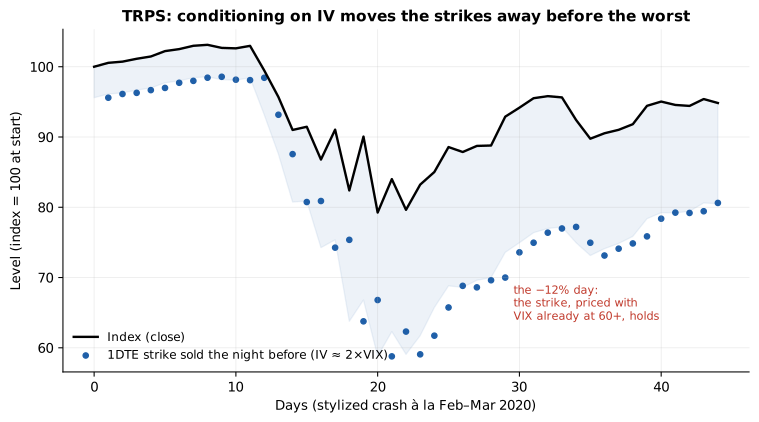
A stylized February-March 2020-type crash: each blue dot is the strike sold the evening before under the IV ≈ 2× VIX rule. When the −12% day arrives, the previous day’s rate had already moved the strike out of reach.
The accessory leg. Tactical long-dated puts, 30-180 days, sold only in blowups with a high VIX and an oversold market, at grotesque strikes (70% below the index, premium $0.70-1.00): the one discretionary component, the insurer writing catastrophe policies while rates are hysterical.
Sizing, stops and the three levels of defense#
I pick up the hierarchy from the Risk management page, now filled in with numbers.
Existential defense: leverage. The overnight leg’s notional is sized at 3-4 times the account value (the reference track record claims to push toward the maximum that portfolio margin allows, but the real constraint is ergodic: the test from the Ergodicity page — a 15% gap beyond the strikes, stops useless — must return a loss on the order of 30-40%, survivable, and at 3-4x it does; at 8-10x it doesn’t). I started much lower, at 1-2x for the first six months, following the strategy’s golden rule — never a position you couldn’t hold to expiration if the stop failed.
Tactical defense: stops. A stop on every position, at a multiple of the premium collected: the reasonable range is 5-20x (5x = many false alarms and small losses; 20x = few alarms and losses that burn 2-4 weeks of premiums: you pick a point and keep it, because changing the rule after every outcome is the surest way to get the worst of both). Since 2025, after the absurd fills of the autumn flash crashes, the strategy has moved from stop-loss (market) to stop-limit orders, with the limit 1-3 ticks above the trigger; the residual risk — the price jumping over the limit — is accepted, once again, because leverage makes it survivable. Stops on the overnight positions are staged in the evening and go live at the open: at night they do not exist, and that must never be forgotten.
Tactical defense, night version: the guard. Option stops sleep, but ES futures trade nearly 24 hours: that’s the hook that lets you arm a sentinel over the uncovered window as well. The automated version I built — the bot’s night guard, described in detail on The TRPS bot page — comes in two alternative variants, both hooked to a trigger on the ES future halfway between the sale price and the strike: the buyback of the put (a conditional GTC order that closes the position during the night: a definitive overnight stop-loss, paid for in panic premium) and the static hedge with ES/MES futures (native CME stops that on trigger sell futures for the put’s estimated delta: a shock absorber that mitigates the decline but doesn’t eliminate it, because the size doesn’t chase the delta as it keeps growing). Neither changes the hierarchy of defenses: an instantaneous gap that reopens beyond the trigger jumps over the guard too, which is why leverage remains the existential defense and the guard only the tactical one.
Structural defense: it’s the one-day expiration itself — tiny vega, daily reset, 252 near-independent trials a year that put the CLT to work legitimately (Ergodicity page).
For those without portfolio margin, or who want an absolute cap on overnight risk, there’s the spread variant: buy a much lower put against the one sold, accepting a smaller net premium in exchange for a defined maximum loss. The reference track record used it on the longer expirations and abandoned it for naked puts (more premium, margin still efficient), but for a small account it remains the honest way in.
The real numbers#
The reference track record’s 2025, from the public reports: over 10,000 contracts, 6.5 billion of cumulative notional, $121,000 in gross premiums, roughly $104,000 net overall. The premium capture rate: 94% on the 1DTEs (only two losses, both false alarms). In return terms: the arithmetic from the Capital efficiency page — 0.15 × 252 / 7,300 ≈ 0.5% unlevered, times 3-4 of leverage — gets you to 1.5-2% a year of alpha on the account from the main leg, to which the tactical long-dated puts add an episodic contribution in high-VIX regimes (the reference track record, which runs other legs alongside the 1DTE, delivers more — still down from the 10%+ of the first decade, due to de-risking and premium compression: Edge page). Recent double-digit Information Ratios, no losing month since June 2022, regression alpha of about 7% with a t-stat near 7 over the full history — and by this point in the site you know how to read these numbers correctly: an excellent process and a tail not yet realized in the sample, both at once (Risk measures page). For the US taxpayer, everything is Section 1256: 60/40 and one line on Form 6781.
The weak points, no sugarcoating#
The overnight gap is the strategy’s defining risk. The daytime stops sleep while the puts are open; the BoJ shock of August 2024 opened positions above any stop. The night guard described above now covers a good part of that window — it was born exactly for this — but it has to be weighed for what it is: a conditional order or a static hedge that work well in continuous declines and can do nothing against the instantaneous jump that reopens beyond the trigger. The fundamental answer remains structural: leverage, sized on the disaster. The question I asked myself before starting was whether I could calmly accept the possibility of a −30% in a single night, once every decade or two; the spread version exists precisely for those who answer no to that question.
Israelov’s critique. Deep OTM puts are the region of the surface worst paid per unit of stress-test loss (Risk measures page): TRPS deliberately chooses a sky-high IR and a mediocre STAR. The defense — partially convincing, and I discuss it in TRPS vs DHCS — is that Israelov’s analysis is unconditional on monthly-expiry strikes, while TRPS lives off daily conditioning: the stress that matters isn’t “−20% from here” but “−20% overnight with no warning”, a much rarer event. Partially, though: the Peso quarter (Tail risk page) lives exactly here.
Microstructure bites. Margin released late in the post-close window, broker constraints on stop-limits, bad fills on the wrong strikes, IB’s exposure fee for accounts that get too cheerful: none of these details is fatal, but all of them together are what separates a 94% PCR from a 75% one. Two execution habits worth real money: you always sell with limit orders, starting from the mid and conceding one tick at a time — on a 15-cent premium, giving away the whole spread means giving away a third of the gross margin; and you account for the operational queue of the evening window, where an order can be rejected because the margin from the just-expired puts hasn’t yet been released by the broker’s system — the rejection is not an error but an expected event, and the correct response is to retry after a few minutes, not to raise the size or chase the price.
Boredom is a risk. 252 identical evenings a year to collect 15 cents per contract: the temptation to “optimize” — closer strikes after a good month, extra leverage after a good quarter — is the true long-run killer, and it’s why this strategy is the perfect candidate for automation (the first of the three bots from the introduction runs exactly this routine, plus the night guard described on its page).
Parameter recap (plausible ranges): 1DTE expiration; selection at a fixed premium of $0.10-0.25 / IV of 1.5-2.5× VIX; prominent strikes; overnight leverage of 1-4x the account depending on your own ergodic test; stop-limits at 5-20x the premium, active only during the session; night guard in one of the two variants (conditional buyback or static futures hedge), trigger at 0.2-0.5 of the fill-to-strike distance; tactical long-dated leg only at an elevated VIX. Everything else is discipline.
TRPS does, however, knowingly leave two things on the table: the delta (small but present, which makes it a relative of equities on bad days) and the central part of the surface, where Israelov showed the premium per unit of stress is at its highest. The strategy that harvests exactly what TRPS leaves behind is the next page.